Not many companies out there are creating devices that unite everyone's experience together into one, at a price they can afford.
If you have an iPad in the classroom you might be streaming to your projector via an Apple TV. Maybe you stream wirelessly through AirPlay. What if you have an Android device? What if you want to stream your laptop wirelessly? What if you want to stream your Windows laptop wirelessly?
Yes, there are solutions out there already. Do they all work together in one solution? With one little adapter? For only $35???
ChromeCast has the potential to replace interactive whiteboards in the classroom. With one wall mounted TV, you can stream content from your Android, iOS, or any computer with a Chromebrowser and a wifi connection.
As more and more developers add the ChromeCast element to their Apps (which does not require a complete redesign of an existing app, unlike some platforms...) the ability to use the wireless device for control of the TV experience (now the whiteboard) becomes affordable for everyone.
What I love about this solution is that it is cross-platform (iOS, Android and Chrome), cheap ($35), and accessible to most people. Not many companies out there are creating devices that unite everyone's experience together into one, at a price you can afford.
Friday, July 26, 2013


Wednesday, June 19, 2013
Should Students have Multiple Devices?
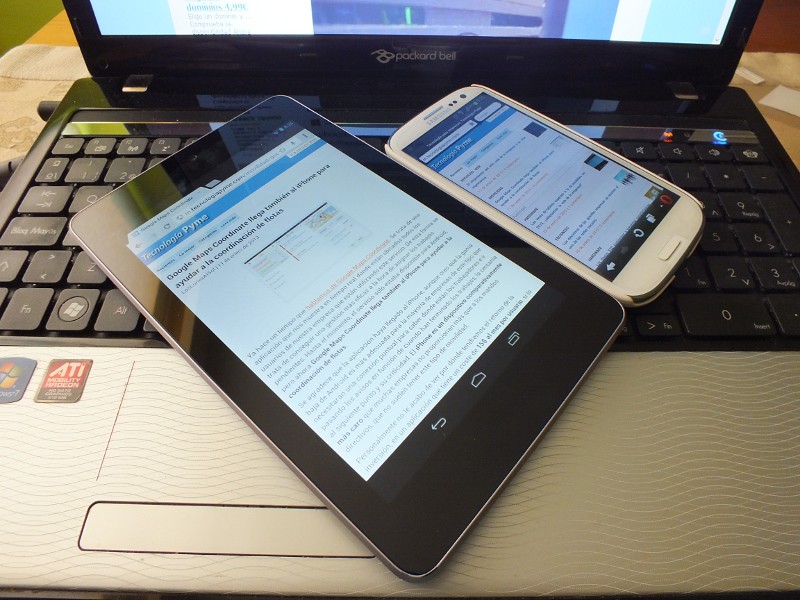
Laptops, tablets, smartphones, how many devices should a student have for school? I still think that someday there will be the ONE, the one device that connects everything together. That device may require some implants and numerous patents that do not yet exist. So, let's stick to the present day and address the question: How many devices should a student have?
I recently had a casual conversation with a Google Android Engineer on this question. "How do you picture your end user? Do you think they will have one Android device and that's it?" I thought I was going to get an insider's view of "The One" prophecy, instead I got an amazing anecdote.
You know, when I held my first tablet several years ago, I thought to myself, "The only thing I would ever use this for is reading in bed." Then it donned on me; Why don't I use this for reading in bed?!? That's a great idea, and so, I put one on the nightstand!
Embrace that devices serve finite purposes.
That was all I needed to send my cortical gears spinning!
The tablet debate rages on. Teachers are posting articles on the 100 best apps for education, publishers are vying for market share in the reader app market, schools scramble to get their name in the paper as the next 1:1 tablet school. It's a hot topic and a phenomenally powerful device hands down! Tablets have amazing apps for education and are great for reading, true! If we spend all of our time trying to justify using only a tablet device in the classroom however, we get bombarded with exceptions! "I need proprietary software, that's not an App", "I need a USB port for an external instrument.", "I can't type on a miniature keyboard." The excuses mount as you try to replace the laptop or all other educational technology with the one tablet. So stop fighting! Don't have just one device!
Ideally, the current Tech Student would have two devices. A laptop and some other "smart" device like a tablet or phone. The laptop is still the most powerful computing device available. I won't go into all of the specs to compare, as I am sure there is a reader who is disagreeing with me at this very moment. When it comes to writing essays, using scientific instruments (that require proprietary software not available in an App) and for efficient multi-tasking, the laptop wins. So, keep the laptop. The second device is the tablet or phone! Load every reader app and have students purchase completely digital books! I have informally surveyed students about digital books: They love them! Overall, they have no problem reading digitally and enjoy the ability to store notes electronically. Smart devices have instrumentation of their own: gyroscopes, gps, cameras and more! Use them! Find apps that supplement what is on the laptop. Stop trying to find a 100% replacement solution and embrace that devices serve finite purposes.
I know that there are limited resources in education. Some schools have no choice but to choose one device or have a Bring Your Own Device model that attempts to get one device in the hands of all students. Choose the right device for the situation you have. I am fortunate enough to have a 1:1 laptop program in my school and we have struggled with the "can we replace laptops with tablets?" question for a while now.
We are looking at a two device solution as far as the ideal Tech Student. They will use the tablet and laptop for their strengths. Use the App when there is one, use the computing power when needed. Keep it simple!
Tuesday, May 28, 2013
Register! Harker Teacher Institute 2013 - Sat. June 8
It's not too late to sign up for the annual Harker Teacher Institute!


The Harker School has again partnered with SVCUE (Silicon Valley Computer Using Educators) to host our annual Teacher Institute on Saturday, June 8th at Harker’s Upper School campus from 9:00 AM to 2:00 PM. The $20 registration fee includes three sessions, lunch, and a 2GB thumb drive!
Some of the topics being presented include:
- Singapore Model Drawing: A Visual Approach to Word Problems
- NoodleTools: Tools for Student Research
- Going 1:1 with Chromebooks
- Google+, Hangouts, Oh My!
- Using MinecraftEDU for Learning
- Digital Grading with Google Docs
- Alternative Assessments in History
Please go to the following page to register: http://tinyurl.com/HarkerInstitute
Please forward this news to all your colleagues and educator friends. We hope you can join us!
Instructional Technology Department
The Harker School
Daniel Hudkins, Dir. of Instructional Technology
Lisa Diffenderfer, Asst. Dir. of Instructional Technology, Lower School
Scott Kley Contini, Asst. Dir. of Instructional Technology, Middle School
Diane Main, Asst. Dir. of Instructional Technology, Upper School
Subscribe to:
Posts (Atom)